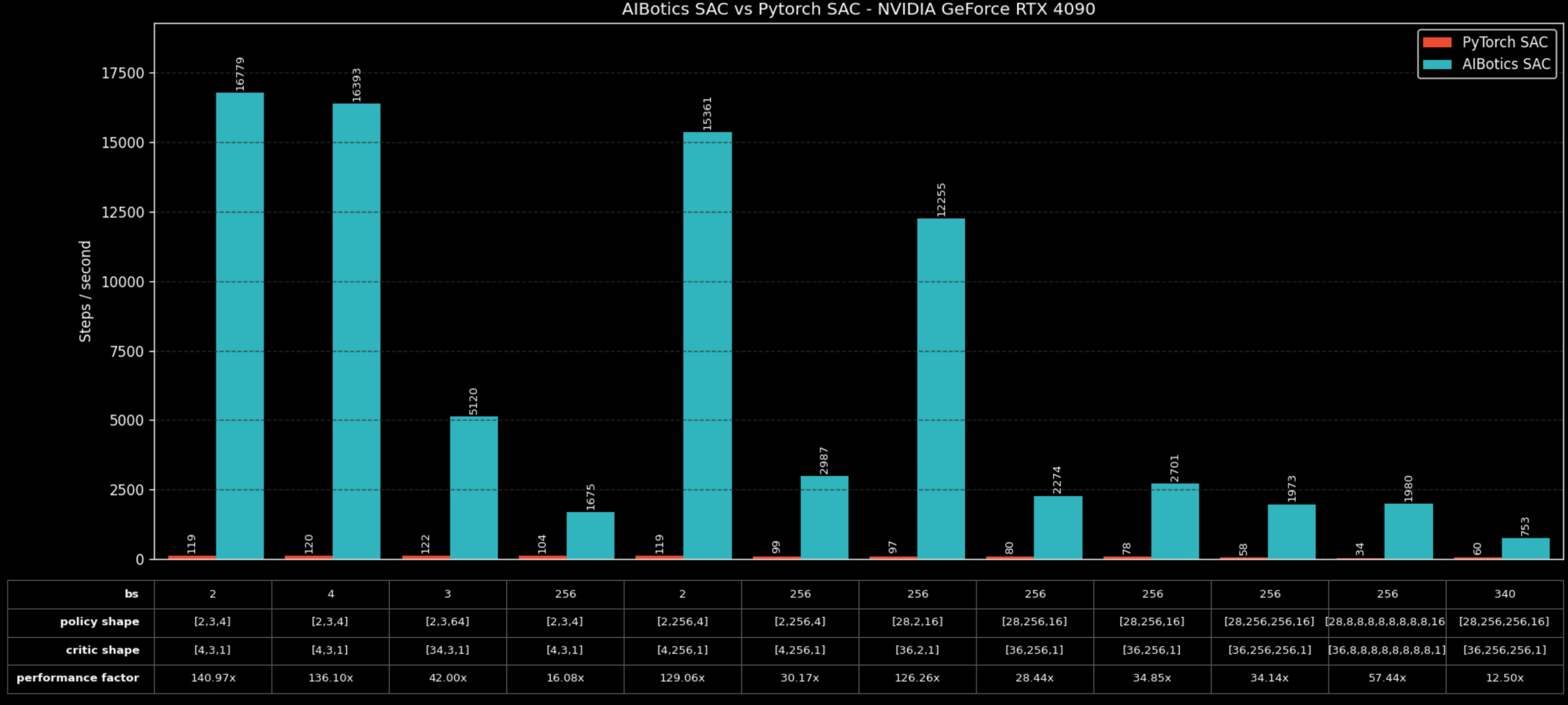
Introducing the AIBoitcs Soft Actor-Critic (SAC) implementation — fully custom, engineered in CUDA for extreme speed and efficiency.
Engineered to reduce framework overhead, kernel-launch overhead and memory latency.
When one training run takes hours, days or weeks, a faster SAC implementation shortens
the wall-clock wait. Results arrive sooner, failed approaches are discovered earlier and
the next development decision does not have to wait for the current run to finish.
02Reduce energy costs
Completing the same amount of training in less GPU time reduces the energy required for
that workload. The exact saving depends on GPU power draw and utilization, but efficiency
lowers both electricity consumption and the associated cooling demand.
03Run more experiments and discover more
Use the same compute budget for more random seeds, hyperparameter searches, ablations,
reward designs and environments. More evidence in the same period accelerates research
and makes conclusions more reliable.
04Free existing GPUs for other work
Shorter SAC workloads release capacity for simulation, inference, other training jobs
and additional teams. Existing hardware becomes available sooner instead of remaining
occupied by one long-running experiment.
05Save money on GPUs
Faster SAC training gets more work from every GPU you already own. That can reduce the
number of accelerators you need, delay new purchases and lower hardware spending.
06Avoid the full cost of “just buying more GPUs”
Recent AI-driven demand has increased prices and tightened availability across GPUs and
related server components. More GPUs are also not a perfectly proportional shortcut:
distributed training introduces communication and synchronization overhead, while every
server has finite GPU slots, PCIe capacity, power, cooling and physical space.
Once the current servers are full, the next GPUs can trigger an entire infrastructure
expansion—not merely another accelerator purchase:
Additional server chassis, CPUs, memory and storage
Networking equipment, switches, cables and accessories
More rack space, power distribution and electrical capacity
Additional cooling, airflow or liquid-cooling infrastructure
More floor space, installation effort and ongoing maintenance
Extra operational complexity across the whole cluster
AIBotics SAC lets you scale through software efficiency first—before committing to more GPUs,
servers, racks, power and data-center space.
How AIBotics SAC achieves the speedup
AIBotics SAC was built specifically for Soft Actor-Critic training instead of expressing
the algorithm as many separate framework operations. This reduces the overhead around the
neural-network calculations and allows the GPU to spend more time doing useful work.
A single CUDA kernel call
The complete Soft Actor-Critic training update is executed in one custom CUDA kernel
call. This removes repeated kernel-launch overhead between the actor, critics and
entropy updates.
No Python or PyTorch overhead
The performance-critical training path runs directly in C++ and CUDA. It does not
require Python and PyTorch to schedule many individual operations during every update.
Optimized GPU data flow
The implementation was designed holistically for low latency, minimizing unnecessary
intermediate work, framework coordination and memory latency across the SAC update.
Benefits:
Train Faster, Save Money GPUs and on electricity , Accelerate Research.
Use fewer GPUs for the same results.
Save thousands of dollars annually on hardware and energy.
Scale experiments without scaling costs
How we achieved that:
We holistically optimized for fast training speed and low latency and reduced the overhead to the bare minimum.
The entire Soft Actor Critc Learning is done in a SINGLE CUDA KERNEL CALL. Completly eliminating kernel call overhead, python overhead, pytorch overhead...
Built from the ground up for performance, this SAC implementation eliminates Python overhead and minimizes memory latency — giving you unparalleled training speed.
Train models days or weeks faster.
Features:
✅ 10x–50x faster than PyTorch-based implementations
✅ Designed for GPU-first training — no wasted CPU cycles
✅ Highly optimized kernels for actor, critic, and entropy updates
✅ Full source code access — modify and extend as you wish
✅ Clear documentation — easy to integrate into your own projects
✅ Ideal for Sim2Real, robotics, autonomous systems, and large-scale RL research
With GPU prices continuing to rise, simply buying more hardware is becoming an increasingly expensive way to scale reinforcement learning.
AIBotics SAC delivers a highly optimized CUDA implementation that extracts far more performance from existing GPUs—reducing the need for
additional, overpriced hardware.
Training efficiency isn't just about speed — it's about direct cost savings. A single high-end GPU (like an A100 or H100) costs $10,000–$40,000. Multiply that across a cluster, and inefficient code quickly becomes a six-figure loss.
A 10x–50x speedup means you can finish in days what normally takes weeks — or scale your cluster down massively without sacrificing results. In large operations, this can translate into saving hundreds of thousands of dollars annually in hardware, electricity, and engineer time. Unlike simply "buying more GPUs," software-level acceleration multiplies the value of every GPU you already own — instantly and without new hardware investment.
Not sure what performance to expect? Share your SAC parameters, including batch size, obs/action sizes, and policy/critic network shapes, and we’ll benchmark your exact configuration before you buy.
Disclaimer: The current implementation supports MLP-style networks based on standard fully connected/linear layers.
Convolutional networks, recurrent networks, attention-based architectures, and other custom layer types are not currently supported.
However, if your project requires additional architecture support, we can discuss a custom implementation option.
Pricing
Choose the license that fits your needs. All options include fast integration and detailed documentation.
Need custom features or enterprise licensing? Contact us.
Ready to take your RL to the next level?
👉 Purchase today and get full source code + integration guide.
What is Soft Actor-Critic?
Soft Actor-Critic is a reinforcement-learning algorithm that learns complex control
tasks while balancing reward maximization with continued exploration. It has achieved
state-of-the-art performance in:
Self-driving cars
Robotics
Industrial applications
Aerospace and drones
Games
Frequently asked questions
Common questions about performance, compatibility, integration and licensing.
How much speedup can I expect for my SAC workload?
Performance depends on batch size, observation and action dimensions, and the policy
and critic network shapes. The performance details section below shows measured
examples across several configurations; we can benchmark your exact setup before purchase.
Which neural-network architectures are currently supported?
The current implementation supports MLP-style networks built from standard fully
connected or linear layers. Convolutional, recurrent, attention-based and other custom
layer types are not currently included. Contact us if you need a custom implementation.
Does AIBotics SAC require Python or PyTorch during training?
The optimized SAC update path is implemented directly in C++ and CUDA and is designed
to avoid Python and PyTorch framework overhead. The binary package exposes a public C++
API and includes a quick-start guide and example.
What is the difference between the Binary and Full Source licenses?
The Binary License provides the precompiled CUDA library, public C++ API, documentation
and commercial usage rights without source access. The Full Source License additionally
includes the C++/CUDA source code, CMake build system and the right to modify and extend
the implementation.
Can AIBotics benchmark my exact configuration before I buy?
Yes. Send us your batch size, observation and action dimensions, and policy and critic
network shapes. We will test the configuration and share the expected performance before
you make a purchase decision.
Performance details
Full benchmark results across batch sizes and policy and critic network shapes.
Update times are shown in microseconds.